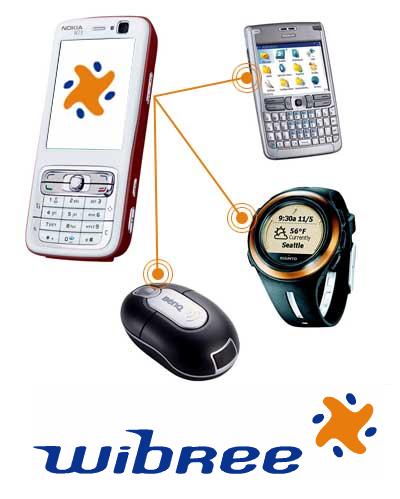
Wibree's development started at the Nokia Research Center in 2001. Wibree was announced to a broader audience in October of 2006 and Nokia stated its intention to incorporate the technology and its current forum into an open, preferably existing industry forum to ensure Wibree's wide adoption.
To this day Broadcom, Casio, CSR, Epson, ItoM, Logitech, Nordic Semiconductor, ST Microelectronics, Suunto, Taiyo Yuden Co., Ltd. and Texas Instruments have contributed to the interoperability specification, profiles and use case definition of Wibree in their respective areas of expertise and will continue this work in the Bluetooth SIG working groups. Several new companies, including device, watch and access systems manufacturers will join the finalization of the specification. Once the specification is finalized, the technology will be made broadly available to the industry via the Bluetooth SIG.
From the start, Wibree was designed to work with two implementation options - as an easily implemented extension to a classic Bluetooth radio, and as a stand-alone implementation.
The Bluetooth SIG recognized the potential of Wibree to enhance current Bluetooth use cases around the mobile phone and PC by bringing very low power, sensor type devices into the fold. The ultra low power extension will allow watches and toys, as well as sports & wellness, healthcare and entertainment devices to be easily added to one's personal area network. This opens a new range of mobile possibilities for end users.
By leveraging Bluetooth technology's high consumer awareness (86 percent globally), the Bluetooth SIG's large membership and proven development and qualification programs, the ultra low power solution will be integrated faster and at a lower cost to the industry and consumers. Thanks to its innovative design, Wibree consumes only a fraction of the power of classic Bluetooth radios. In many cases it makes it possible to operate these devices for more than a year without recharging.
As stated in his March 2007 ABI Research Short Range Wireless Service, research Director Stuart Carlaw predicted a $432 milllion, 809 million device industry for Wibree by 2012. Carlaw said, "We believe [Wibree] is a unique technology that can leverage the very positive market position of Bluetooth technology in segments such as medical, sports equipment and well-being, where the total available market is extremely large and still relatively untouched."
The work of integrating the low power technology within the existing Bluetooth specification has begun and the first version of the specification is anticipated during first half of 2008.
Wibree Technology